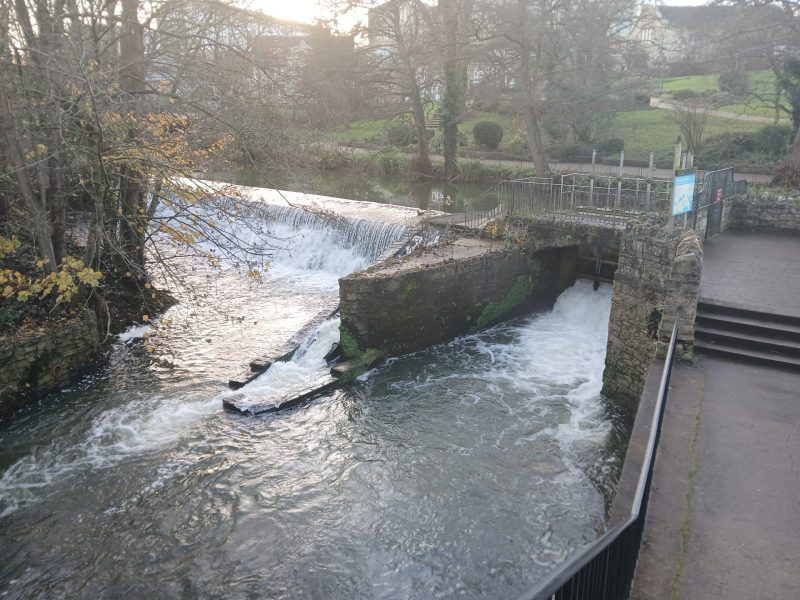
PLANS to remove the weir in Keynsham Memorial Park appear to have been dropped, it has emerged.
There has been confusion about the weir’s future since its removal was first mentioned in a draft of the Keynsham Town Centre Regeneration Plan, released early last year.
Bath & North East Somerset Council said removing the weir would make it easier for fish to pass along the River Chew, which runs through the park.
But in the approved version of the plan, issued by the council last autumn, there is no reference to the weir’s removal in an appendix about the park improvement project.
Yet a shorter document described as a council executive covering report still mentions the proposal to remove the weir.
When the Voice asked B&NES Council whether this reference to removing the weir was still correct, it did not directly answer our question, instead supplying a statement similar to the appendix.
But a council manager whose portfolio now includes the park and weir project has told a Voice reader concerned about the weir’s future that the report’s reference to its removal is inaccurate.
They told Paul Benn in an email: “The project you refer to is in the early feasibility stage to explore opportunities to improve the river and weir for fish passage through Keynsham Memorial Park.
“We are currently gathering data and evidence to understand the risks, costs and benefits of any interventions to the weir and river, and at this stage no decisions have been made.
“Incorrectly, the report that accompanied the Keynsham Action Plan (3.7) did reference removal of the weir, which is not the case as we are only at the optioneering stage.”
The Keynsham Town Centre Regeneration Action Plan focuses on such themes as shopping, travel, arts and culture.
The appendix that details the projects that make up the action plan describes the weir as a remnant of Keynsham’s industrial past, which served the water mill that is no longer there.
It continues: “The weir is the most downstream barrier to fish passage in the River Chew catchment, and obstructs migratory fish such as Atlantic salmon, sea trout, sea lamprey, European eel, and resident coarse fish species from travelling up the watercourse.
“The weir stops water flowing naturally, creating a slow-moving section of river like a canal, which causes build-up of silt and loss of biodiversity. This has contributed to localised flooding along the riverbank in recent years.
“Previous public consultation has highlighted how important the green space and wildlife of the park is to local people, and that there are existing concerns around the deep silt and regular flooding of footpaths.
“The council, with other partners, is exploring options for the future of the weir to improve the river for wildlife, especially within Keynsham Memorial Park.”
This discrepancy between the covering report and detailed appendix was highlighted by Paul Benn, who is journal and Facebook editor for the Keynsham and Saltford Local History Society.
He told the Voice: “I visited the consultation exhibition in the library in early June, where residents were invited to give feedback on the plans for the park, but there was no mention of the weir removal, resulting in attendees initially giving their support.
“However, following the re-posting of your weir removal information on social media, the public feedback was overwhelmingly negative.”
Paul said: “As a keen historian and environmentalist, I have competing loyalties concerning this issue.”
He added: “The reason why I feel that it is important to protect the weir is that it is of historic importance both locally and nationally as it is probably the earliest known structure built by Abraham Darby, who went on to be a main player in the Industrial Revolution.”
In its response to the Voice, B&NES Council supplied a comment from Councillor Paul Roper, cabinet member for economic and cultural sustainable development.
He said: “We know from consulting on the Keynsham Town Centre Regeneration Action Plan which sets out ambitions for the area that there are concerns around deep silt and regular flooding of footpaths caused by the weir, as well as its effects on wildlife.
“With partners we are in the early stages of exploring the options available to improve fish passage for endangered species, balanced against the heritage value of the weir and flooding risks. These options will be consulted on as the project progresses.”
New twist in Keynsham Memorial Park weir sage